
Disease & Pest Detection (AI Analysis)
Overview
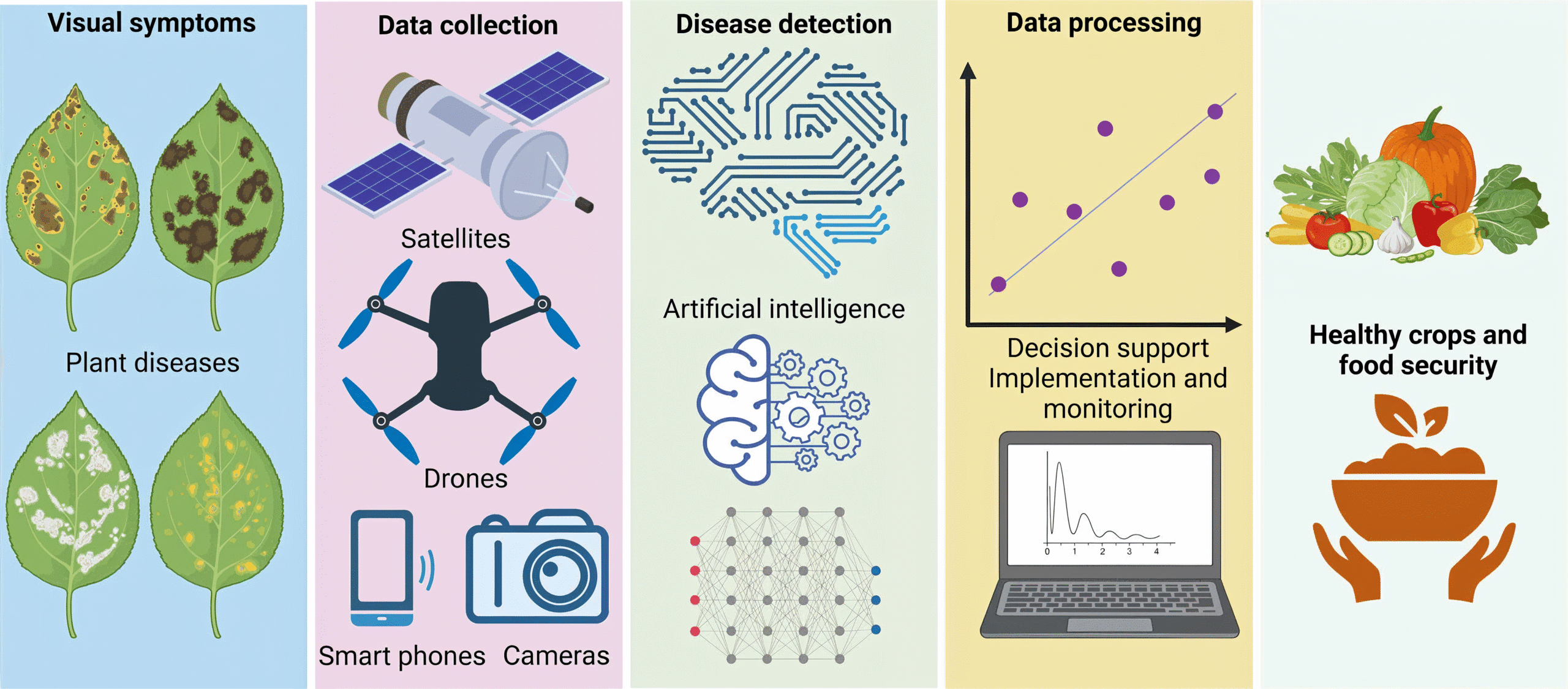
AI-driven disease and pest detection uses high-resolution drone imagery, multispectral data, and machine-learning algorithms to identify early signs of crop stress, infections, and pest infestations. By analyzing patterns such as discoloration, canopy texture changes, chlorophyll variations, and thermal anomalies, the system can detect issues long before they become visible to the human eye. This enables farmers to take rapid, targeted action—reducing crop losses, minimizing chemical usage, and improving overall field health. Automated alerts, geo-tagged reports, and severity mapping ensure precise interventions and significantly higher operational efficiency in modern precision agriculture.
Process Flow
Plant Disease Detection Using Computer Vision in Agriculture | ImageVision.ai
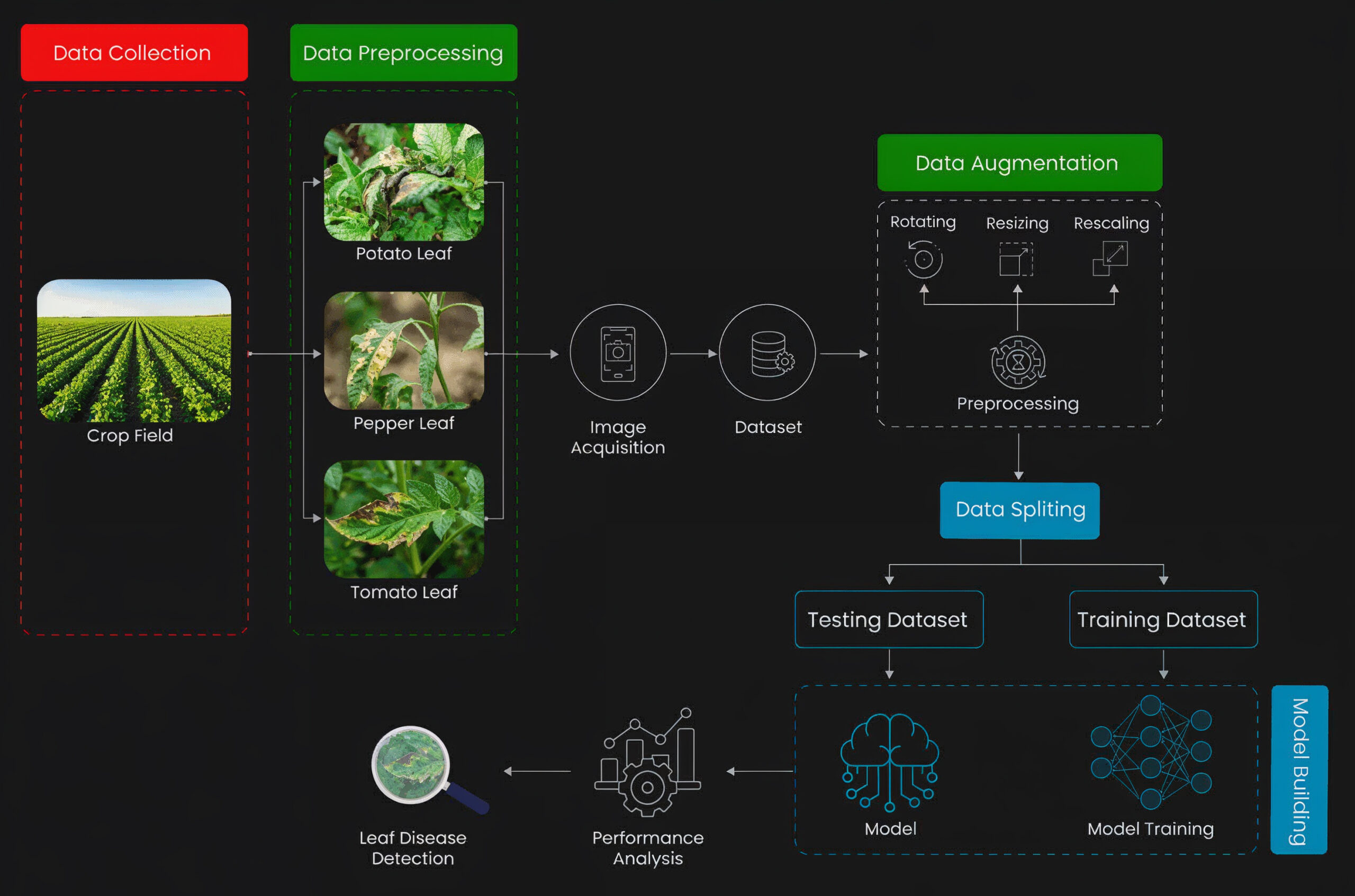
The workflow begins with collecting leaf images directly from the crop field, capturing samples of different plants such as potato, pepper, and tomato leaves showing disease symptoms. These images undergo preprocessing to enhance clarity by adjusting lighting, removing noise, and preparing them for analysis. After image acquisition, the cleaned dataset is stored and passed through data augmentation, where images are rotated, resized, and rescaled to increase dataset diversity and improve the model’s robustness. The augmented dataset is then split into two parts: a training dataset used to train the AI model and a testing dataset used to evaluate its accuracy. The AI model learns to recognize disease patterns during training, and once trained, it processes the testing data to detect leaf diseases automatically. Finally, performance analysis is carried out to measure how well the model identifies diseases, completing the full AI-powered disease detection pipeline
Reference Image
https://bsppjournals.onlinelibrary.wiley.com/doi/10.1111/ppa.14006
Relevant Outcomes / Deliverables
- Accurate detection of infected leaf clusters, canopy stress zones, and micro-level anomalies
- Percentage of crop area affected with severity grading and pest density estimation
- Geo-fenced spray maps for drones or ground sprayers
- Unified visual outputs showing vegetation indices, stress trends, and vitality scores
- Reduced pesticide usage through targeted application
- AI-predicted crop loss versus recovery potential after treatment
- Auto-generated reports, treatment logs, and traceability records for audits
Achievable Accuracy
| Task | Accuracy / Units | Depends On |
|---|---|---|
| Disease / Pest Detection | 70% – 95% | Camera quality, lighting, crop type, disease stage |
| Disease Type Identification | 60% – 90% | Dataset size, model training quality, symptom clarity |
| Affected Area Mapping | 45% – 85% IoU | Image resolution, canopy density, leaf overlap |
| Severity Estimation | ±5% – ±20% | Sensor type, flight height, ground truth validation |
| Early Stress Detection | 65% – 92% AUC | Multispectral data, weather, time of capture |
| Pest Counting | 10% – 40% error | Pest size, motion blur, clustering, shadows |
Key Advantages
- Detects disease and pest stress before visible symptoms appear
- Pinpoints exact infected zones, reducing guesswork
- Enables pesticide application only where needed
- Prevents disease spread through early intervention
- Supports continuous drone-based field surveillance
- Minimizes manual scouting and human error
- Delivers consistent, objective AI-based analysis
- Reduces chemical, labor, and fuel costs
- Provides digital records for audits and traceability
- Generates geo-fenced maps for variable-rate spraying
Compatible Drone Platforms
- Drishti
- Drishti Pro
- Varuna
Supported Sensors / Payloads
- High-resolution RGB camera
- AI-based object detection and classification software
- Edge computing module (optional)
Industry Segments Benefited
Agriculture & Farming, Horticulture & Plantations, Agri-Tech Companies, Seed Production Companies, Crop Insurance Providers, Government & Research Institutions, Food Processing & Export Industry, Greenhouse Farming, Agrochemical Companies, Forestry & Plantation Management.